Wednesday, July 23, 2014

Working with different sizes of Sakura Pigma Micron pens

When I teach the Crescent Moon and Hollibaugh tangles in Zentangle 1 classes and students start filling in the black areas with the Sakura(R) Pigma Micron 01 pen, I always hear this question: "Why not use a pen with a larger point to fill in the black?" 

First, some information about the pens. The ones I have in my collection are an 01, 02, 03, 05, and 08, that vary in their pen width from .025 mm to .50 mm. Here's a sample of those pens and the line widths they produce:


In my view, there's so little difference between the 01 (the standard pen for Zentangle(R)) and the 02 that I don't think the 02 is of much help. The 03, however, is a marked difference and the 05 is a step up above that. I find that the width of the 08 pen is so wide that it's easy to be a little off and perhaps make a horrible "mistake."

Here are my tips for using pens other than the 01:
  • Use the 01 to fill in along the inside or outside of the edges (like a painter "cutting in" around a window) and then use an 03 or 05 to fill the rest of the space.
  • Always use your 01 pen to fill in corners. You just won't be able to exert enough control over the other pens (unless you use a magnifying glass--ugh!) to keep the corners neat.
  • As your 01 pens start to "die," set them aside (marking them in some way helps keep them separated from your other pens) and use them for the hard job of filling in a lot of space.
Or, why not surrender to the process, and the focus, and the slowing down needed to fill in that space with an 01 pen instead of speeding it up by using a wider pen. That's what Zentangle is all about--isn't it? What's your hurry?


Wednesday, July 9, 2014

Now that I have all these finished tiles . . . .

what do I do with them? That's the question that will come up after you've been doing Zentangle(R) for some period of time.

I have a funky picture display "thingy" that's composed of rods with loops at the end sticking up from a base. I put tiles that I particularly like on that display for a few weeks so that I can enjoy looking at them. It's also a nice way to show friends what I've been up to.

Then I might put them in a drawer in my studio storage cabinet for a while.

Finally, I'll get out my Zentangle PocketzPages from CropStop (this is not an endorsement of their product one way or another) into which the square tiles fit perfectly. I put the tiles in the pockets according to date. Then I put the pages in a notebook. I like being able to look back at what I've done in the past to see how my Zentangle work has progressed (or not).

I tack the Zendala tiles onto card stock (three will fit slightly overlapping on one page) with removable stickum of some sort and then put those into vinyl inserts at the back of the notebook. And I just recently learned that Zendala tiles will fit into CD/DVD pockets as well.

What will I do when the notebook is full? Stay tuned . . . . .


Tuesday, July 8, 2014

Zentangle class at OLLI College for Seniors at UNCA, July 2014

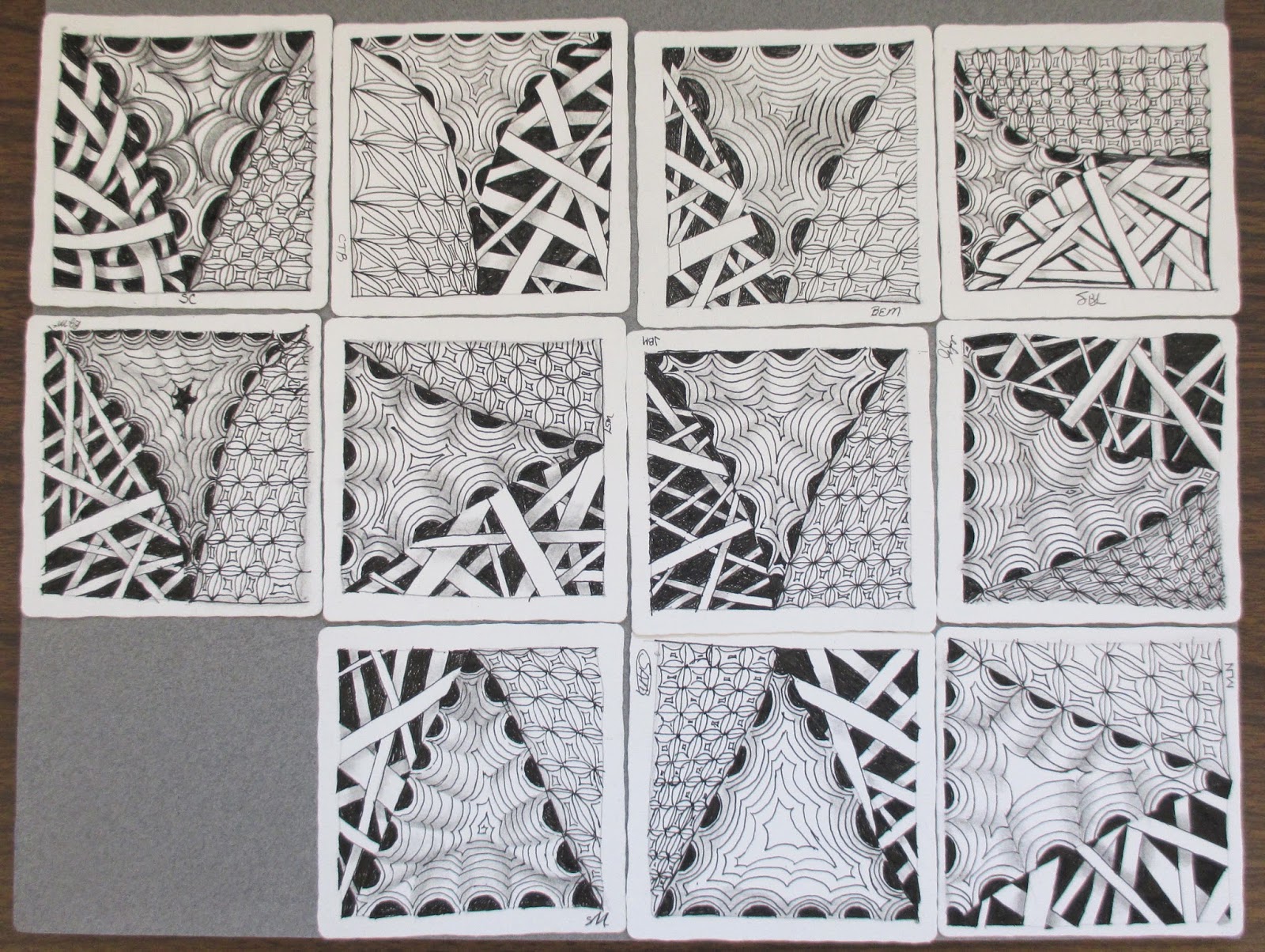
Another group of eager tanglers assembled at OLLI these past two Tuesdays to learn Zentangle. Some were already familiar with Zentangle and some were not, but each one of them brought their very special enthusiasm to the classes. Here is their work!!


Things that the group appreciated about these mini masterpieces included the unique "touch" that each person brought to their version of the tangles and, especially in the second set, the difference that shading made. 

I see once again how challenging triangle-based tangles can be which makes me challenge everyone to do more Rick's Paradox and also try out Lynn Mead's tangle, Fassett


Saturday, June 28, 2014

June 28 Zentangle 1 class

A small but enthusiastic group of tanglers assembled for Zentangle 1 today at The Urban Art Retreat and Studio. Each came with her own artistic capabilities and put her special "spin" on the tangles. I will never lose the sense of wonder and amazement I feel when I see all the students' tiles arranged together. Same tangles, different interpretations. That's part of the beauty of Zentangle.


Wednesday, June 25, 2014

When black pens fade

Sooner or later (Rick Roberts and Maria Thomas of Zentangle think it's 32 tiles later) your Sakura pen will start to fade and finally run out of ink. My experience is that by that time the patented tip is also not delivering a steady line. Do you keep on drawing until it really does run out of ink or is there another strategy?

When I notice that the line isn't full of ink or the tip seems to be giving me a blotchy line, I identify it with a piece of black electrical tape near the end opposite the tip. I use these pens, instead of the ones that are working well, to fill in large black areas. Yes, it takes a bit more time to coax the ink out of a fading pen, but at least I'm not prematurely wearing out a new pen.

Zentangle class at OLLI College for Seniors at UNCA, June 2014

Yesterday was the second of two classes in a Zentangle course at the College for Seniors at UNC Asheville. Lots of good questions and some challenging work with triangles. 

I think triangle tangles such as Rick's Paradox in particular are very challenging--especially when there are multiple triangles next to each other--because they can become visually confusing. I also think that we're accustomed to working with squares and circles but not with triangles.

So here's a suggestion for learning Rick's Paradox: on a plain piece of paper, practice doing multiple solo triangles to get the hang of how it works. When you incorporate it into work on a tile, do only one Rick's Paradox tangle. Then try two next to each other. Also look online at sources such as this post (listed as "Paradox") on tanglepatterns.com which has links to posts on the Zentangle.com website to see the marvelous ways that multiples of this tangle can work out.

And keep working with triangles. They might even beat Sudoku for a brain workout!

Here are the two mosaics from this wonderful group of tanglers.


Wednesday, June 11, 2014

Practicing the familiar

Over time I've been working my way through my CZT resources in order to practice all the tangles, not just the ones I'm familiar with. When I find one that I just can't seem to do "right," I endeavor to practice it repeatedly, perhaps a section of it at a time, until it turns out as close to "the standard" as possible. (In Zentangle(R),  there really is no right way to draw a tangle. Sometimes, "mistakes" lead to new tangles!)

On the other hand, why should I abandon the familiar Crescent moon tangle for a more "difficult" one like Fengle? I've thought of a variety of ways to practice Crescent moon and delve into its potential tangleations (see my Zentangle terminology page):

  • Larger moons
  • Wavy auras
  • Designs within the moons
  • More space between the moons with more auras
What does this sort of practice do for me? It dips into my creative well. When I do that, I find that more options appear than I originally envisioned. And I can see how I could apply some of these options to other tangles. 

Try expanding your knowledge of your favorite tangle by drawing your own tangleations of it.

Disclaimer

The views expressed in this blog may or may not reflect the views of the Zentangle(R) founders.